
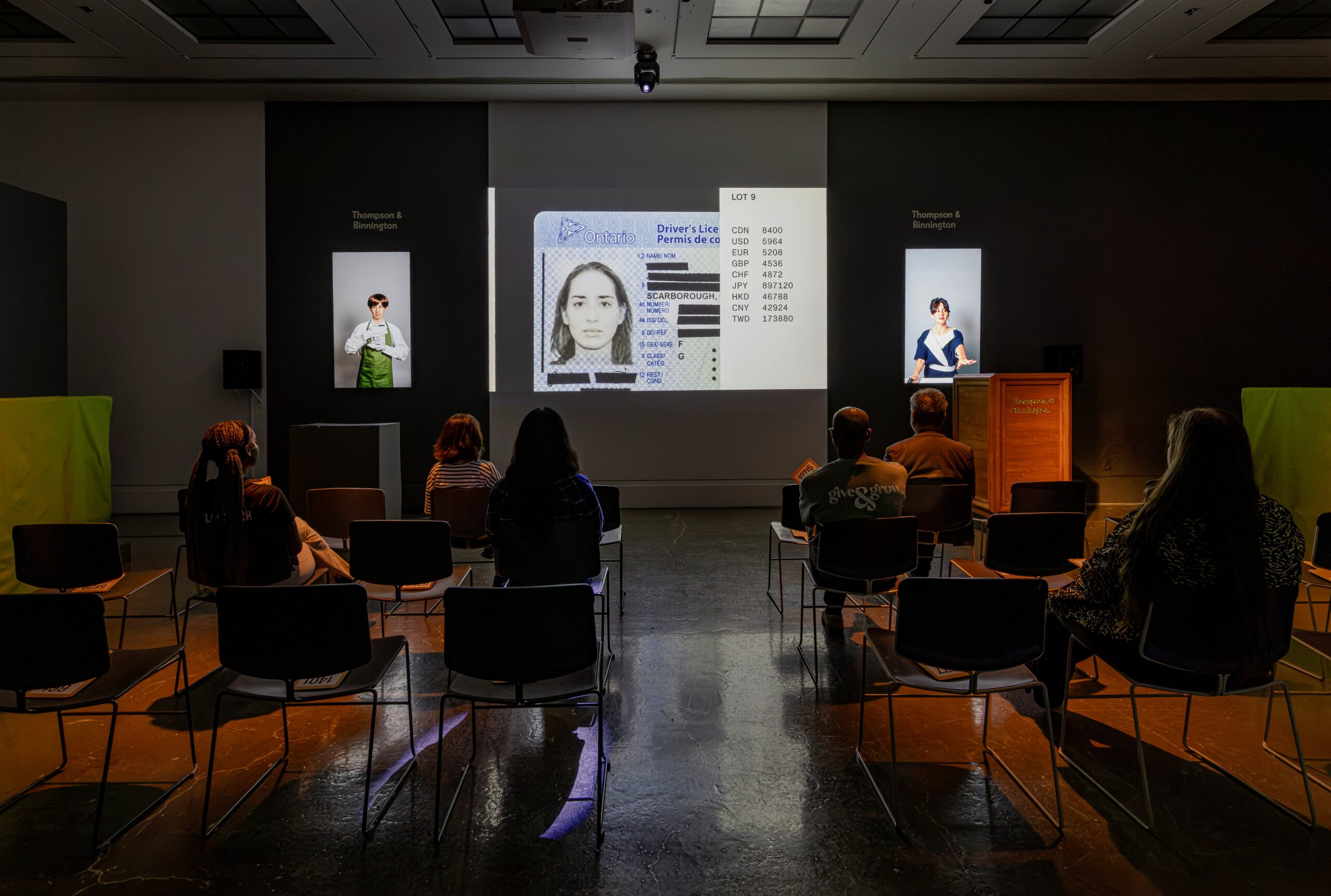
Electric Neon Clock
Artists: A.S.M. Kobayashi
Art Gallery of Mississauga (2026)
Electric Neon Clock is a hybrid, immersive work by A.S.M. Kobayashi that mixes documentary, performance, and installation. Born and raised in Mississauga, and based in Toronto and New York City, Kobayashi is known for her performative projects that take deep dives into found archival material. For this exhibition, the artist turns to her own family archives, which are part of Canada’s history of forcibly incarcerating and dispossessing thousands of Canadians of Japanese heritage.
This project began when Kobayashi first encountered the Canadian government’s WWII custodial file on her great-grandfather and subsequently discovered case files belonging to other relatives, their friends, and a wider community of displaced people of Japanese descent. These historical documents detail inventories of their homes and businesses, and include government correspondence, internal memos, and court transcripts. All adults named in the original documents have passed away, leaving their children, now seniors, as bearers of the only first-person accounts of this period. These living relatives were infants and young children at the time, making the custodial file the most enduring testimony of the artist’s family during those years.
Electric Neon Clock asks: How can the artist liberate forensic practices and state records to undermine their original intention and use them to reconstruct the community and families they were designed to dismantle? Relying on the custodial file as a guide, Kobayashi adapts this record into an installation and live performance detailing her family’s experience. Using video, sound, archival documents, a substantial photo archive, and the innovative format of a live auction, Kobayashi welcomes audiences to delve into her family’s file and join her in assessing the inventory’s value and humanizing its contents.
https://www.artgalleryofmississauga.com/events/a-s-m-kobayashi-electric-neon-clock/
I've Been Here Before
Artists: Cathie Jamieson and Jill Price
Art Gallery of Mississauga (2026)
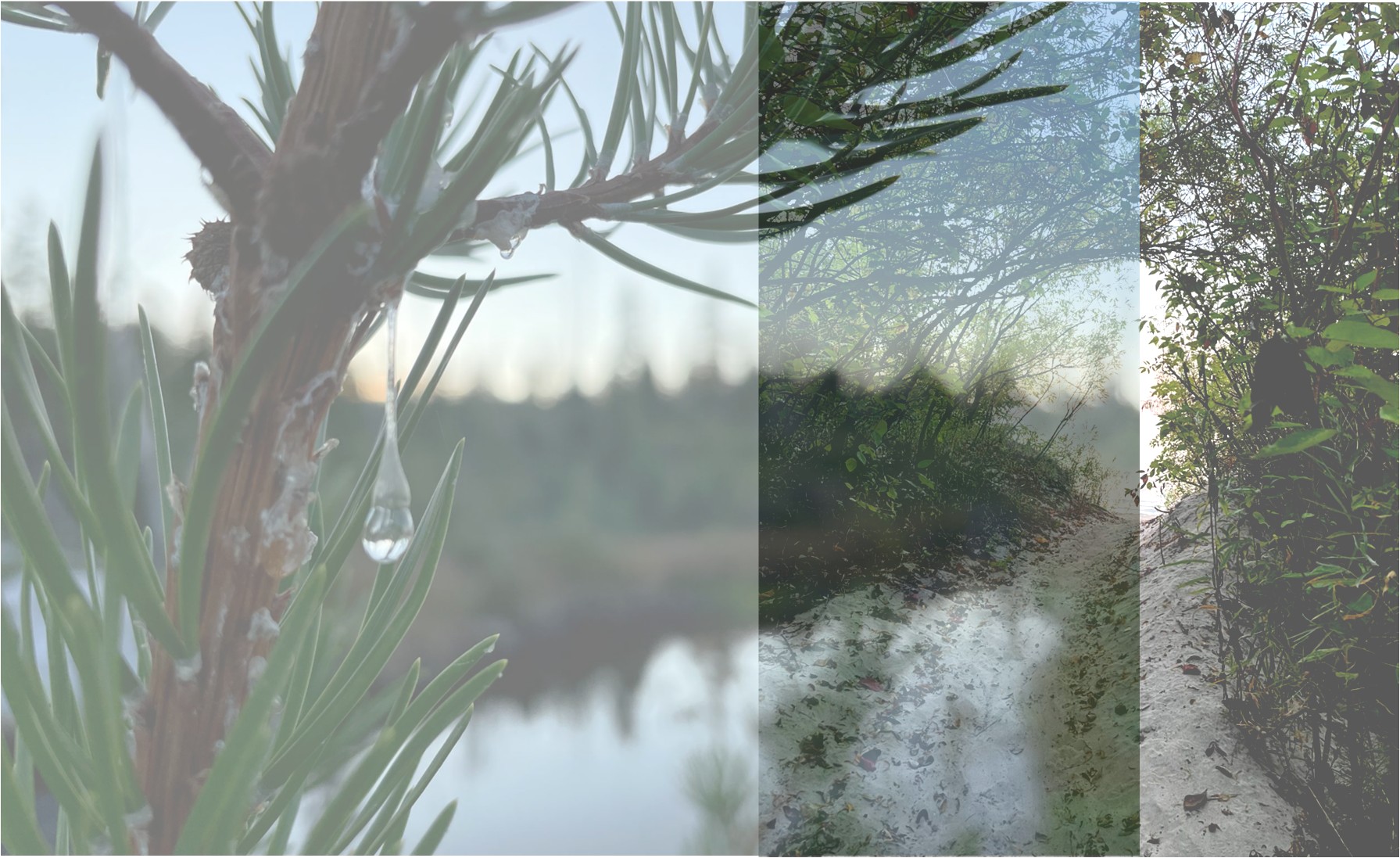
When art evolves through a sensitivity to materials and care for the environment, it can illuminate the implications of our day-to-day behaviours as consumers and urban dwellers. In I’ve Been Here Before, Mississaugas of the Credit First Nation artist Cathie Jamieson and Barrie-based artist Jill Price share their land-based practices, which are both grounded in mindfulness and a commitment to opening up conversations around our collective responsibility to protect the earth.
Jamieson’s work is informed by ancestral Indigenous knowledge of harvesting materials in accordance with natural laws. Through a series of installations using supplies carefully gathered on her Manitoulin Island forest property, such as tree bark and branches, plants, and florals, she brings elements and gestures connected to her teaching practice and healing workshops into the gallery. By centring the medicinal properties and symbolic meanings of these materials, she offers a space for learning and reconnection.
Price’s work considers methods of unmaking systems of harm rooted in colonialism and global industrial capitalism. Her sculptural installations derive from discarded materials she has collected along Ontario shorelines, which are then cleaned, reused, recycled, and repurposed. Informed by a childhood spent along the shores of Lake Ontario and by a sense of ecological urgency, her work reflects the understanding that, in the artist’s words, “environmental harm is not abstract but deeply intimate and shaped by daily consumption and discard.”
Jamieson and Price share important areas of connection in their distinct practices, both of which
invite viewers to reflect on ways of generating acts of care and repair toward the land. Ultimately, I’ve Been Here Before evolves from an understanding that the living systems that sustain and surround us are not passive resources, but active relations whose well-being is deeply entwined with our own.
https://www.artgalleryofmississauga.com/events/ive-been-here-before-cathie-jamieson-and-jill-price/
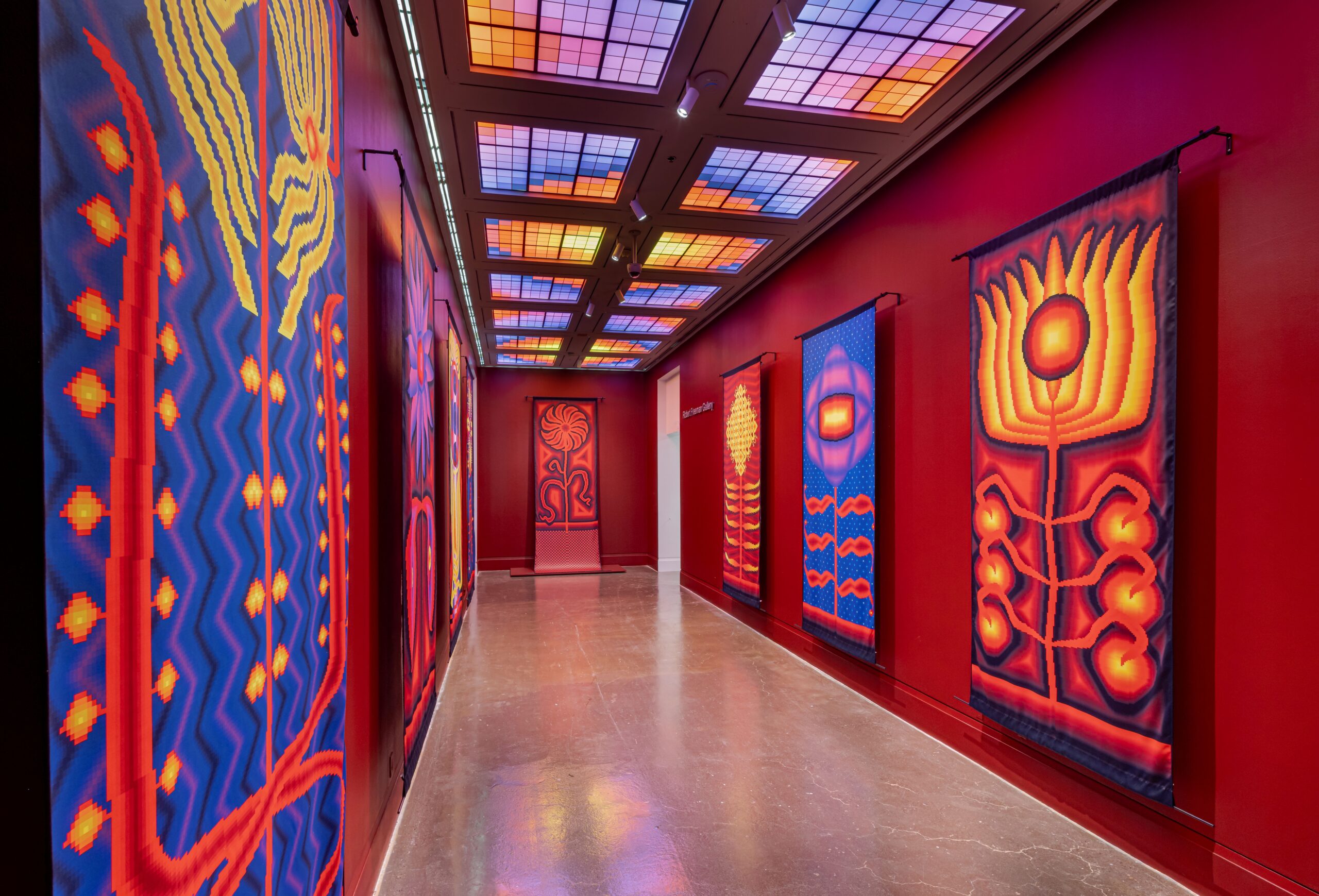
A Petal for a Petal, A Deed for a Deed—The Garden We Could Have Been
Artists: Shaheer Zazai
Art Gallery of Mississauga (2026)
Shaheer Zazai’s installation, A Petal for a Petal, A Deed for a Deed—The Garden We Could Have Been, envisions a world where creation and destruction coexist. Expanding his ongoing exploration of the intersection between digital language and textile traditions, Zazai draws from the history of floral motifs in Afghan carpets and reimagines them at a monumental scale, through towering fabric scrolls and an illuminated ceiling mosaic. These darkly radiant blooms are not ornamental, but act as silent witnesses, emerging from the remains of a world burned by human neglect. Here, a garden of paradise becomes a garden of consequence, as floral sentinels rise in judgement of the destruction humans create and the warnings left unheard.
https://www.artgalleryofmississauga.com/events/shaheer-zazai-%CE%B9-whyishnave-suthagar/

Ninaivu—What We Remember, What We Release
Artists: Whishnave Suthagar
Art Gallery of Mississauga (2026)
Whyishnave Suthagar’s project நினைவு | Ninaivu—What We Remember, What We Release turns toward intergenerational healing within the Eelam Tamil diaspora. At its centre glows a Kolam-inspired mandala, which draws upon traditional Tamil artistic motifs. Additionally, a series of Illuminated texts feature letters exchanged between first- and second-generation Tamil Canadian family members that recall memories of leaving Sri Lanka during its civil war and building a life in a new country. These works speak to the shared but differently experienced journey of diaspora: what is inherited, what is grieved, and what is cherished. At the heart of the space, visitors are invited to write letters of their own, becoming part of an intergenerational conversation that honours memory and fosters healing.
https://www.artgalleryofmississauga.com/events/shaheer-zazai-%CE%B9-whyishnave-suthagar/
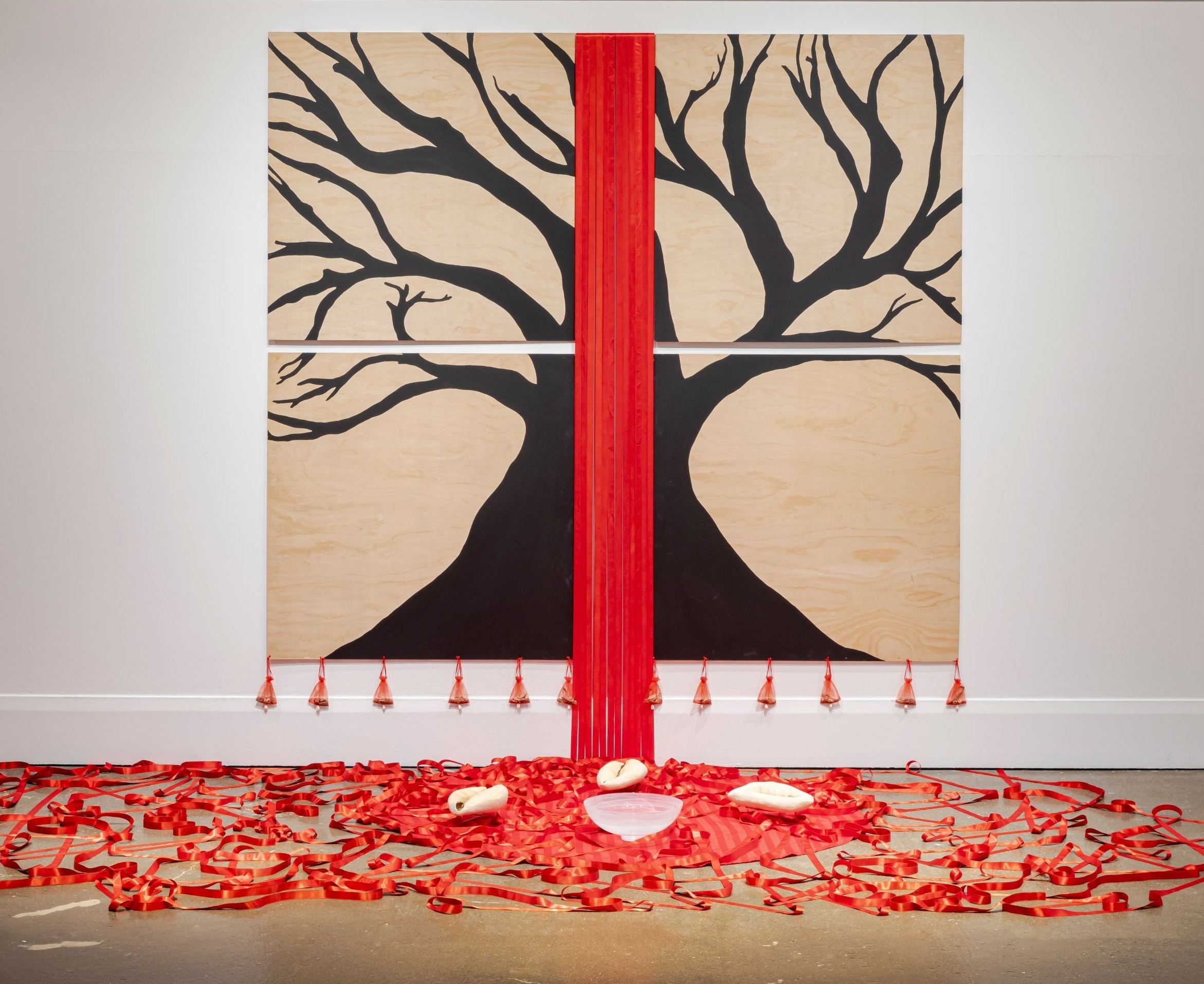
The Search for the Black Madonna and Green Tara
Artists: Winsom Winsom and Tara Darrall
Art Gallery of Mississauga (2025)
Over several decades, Winsom Winsom has expressed her own spiritual journey through her multimedia work and shared her knowledge as a mentor, teacher, and advocate for the arts. For this artist—who has travelled the world and now calls Mississauga her home—art and life are inextricably connected. Her work explores themes of freedom, survivance, resilience, and renewal within the context of the Black Atlantic experience. As a person of African, Maroon, Arawak, Spanish, and Scottish ancestries, Winsom draws from her mixed heritage to incorporate extensive symbolism and ritual references in her work, interpreting the elements, land, animal, and human presence within the context of Afro-centric value systems.
Featuring both existing and new bodies of work by this senior artist and self-described “child of the universe,” The Search for the Black Madonna and Green Tara traces the trajectory of Winsom’s emotional, physical, and spiritual journeys. The exhibition includes an expansive collaborative project with Winsom’s daughter, artist Tara Darrall. Together, they explore the layers of their mother-daughter relationship through a suite of paintings. Guided by aspects of the seven chakras—the energy centres within our bodies—these works are a personal meditation on the artists’ intertwined development of their identities.
https://www.artgalleryofmississauga.com/events/the-search-for-the-black-madonna-and-green-tara-winsom-winsom-and-tara-darrall/
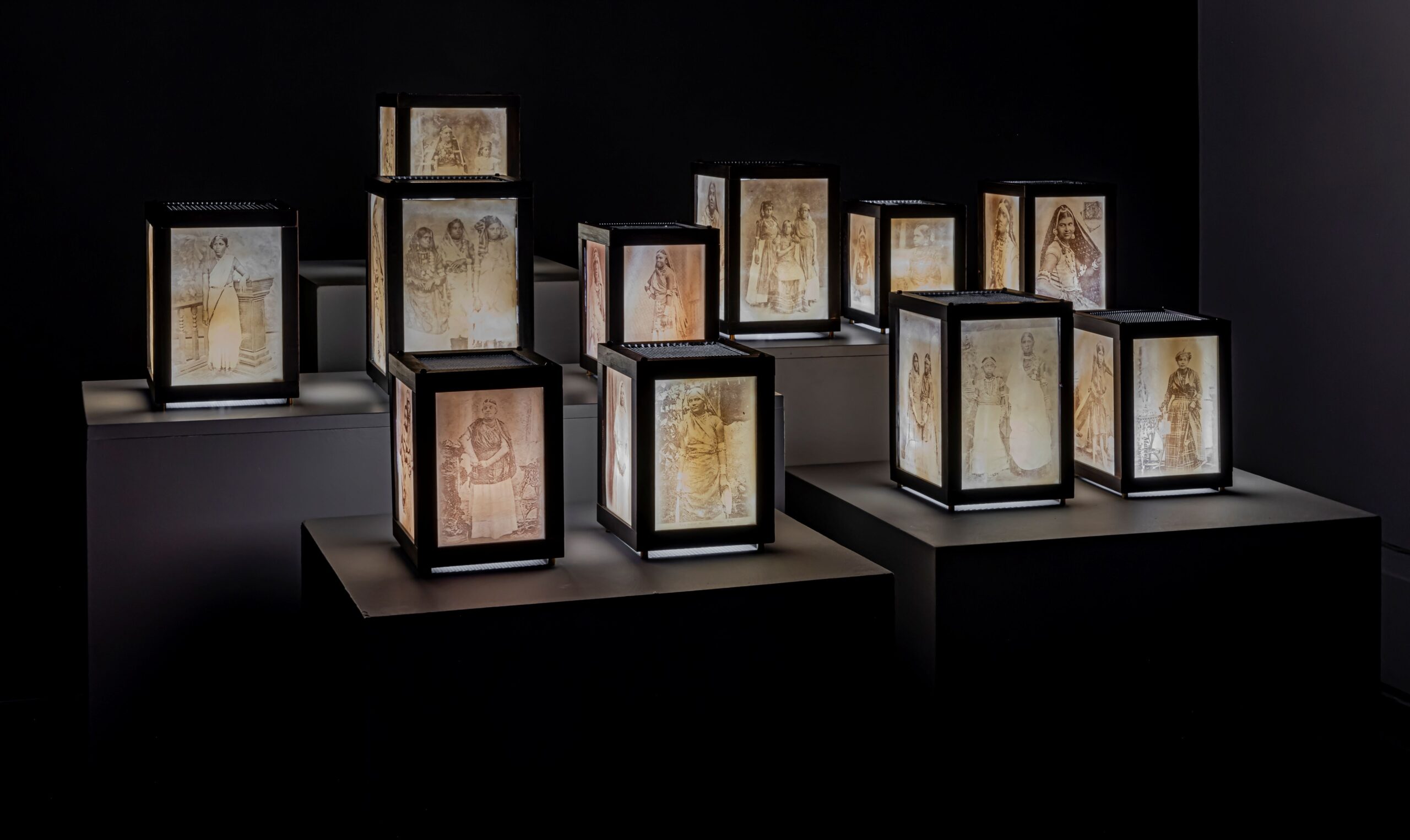
Across Latitudes
Artists: Soheila Esfahani, Heidi McKenzie, and Zinnia Naqvi
Art Gallery of Mississauga (2024)
Across Latitudes examines the intricate realities of moving between cultures and across generations in the process of forging identities and locating our place in the world. The distinct art practices of Soheila Esfahani, Heidi McKenzie, and Zinnia Naqvi all draw from experiences of diaspora to explore the complex terrain of cultural migration and commodification.
This exhibition highlights the artifice of sites and objects that are intended to represent national identity—images in postcards, gift shop trinkets—and how they simplify and misrepresent the realities of lived experience. The works shown here consider the uncomfortable impact of such commodities on the process of shaping personal identity and aim to unravel the stereotypes they perpetuate. By holding these objects up for examination, and by integrating a diverse range of culturally significant markers of personal identity, such as traditional motifs, family and archival photographs, and mementos from childhood, these three artists engage in creative acts of revisiting, reworking, and reclaiming to offer new interpretations and meanings.
The artists in this exhibition inscribe, in different ways, their experiences of belonging amid the construct of what it means to be Canadian. Turning to their uniquely individual paths of migration—with diasporic roots in Iran, the Caribbean, and Pakistan—their works counter the limitations of myth-making and foreground the multi-dimensionality of intercultural experience.
https://www.artgalleryofmississauga.com/soheila-esfahani-heidi-mckenzie-and-zinnia-naqvi-across-latitudes/

Between Us
Artists: Jorian Charlton
Art Gallery of Mississauga (2023)
Straddling the worlds of fashion photography and intimate portraiture, Jorian Charlton’s work emphasizes the beauty and style of her subjects while exploring contemporary modes of Black representation. Between Us brings together images produced in-studio and outdoors to focus on the Mississauga-based artist’s intuitive and collaborative approach toward portraiture and the intimate relationship between photographer and subject.
Charlton’s models are a combination of friends, family, and people she connects with through Instagram. Already aware of how her subjects opt to present themselves on social media, Charlton is interested in working with her subjects to explore alternative avenues of self-expression. While she remains inspired by digital representation, she chooses to work in film, using a medium-format camera. This analogue process is intentionally slower, more technical, and less immediate.
“In my photography, I’m trying to create a visual style that is uniquely my own,” Charlton says. “Regardless of the shoot, I aim to capture my subjects in a timeless way that gives the model a sense of strength and evokes intrigue or connection with the viewer.”
https://www.artgalleryofmississauga.com/events/jorian-charlton-between-us/